
How to Compare Paver Sealing Quotes the Right Way (Before You Make a Decision You'll Regret)
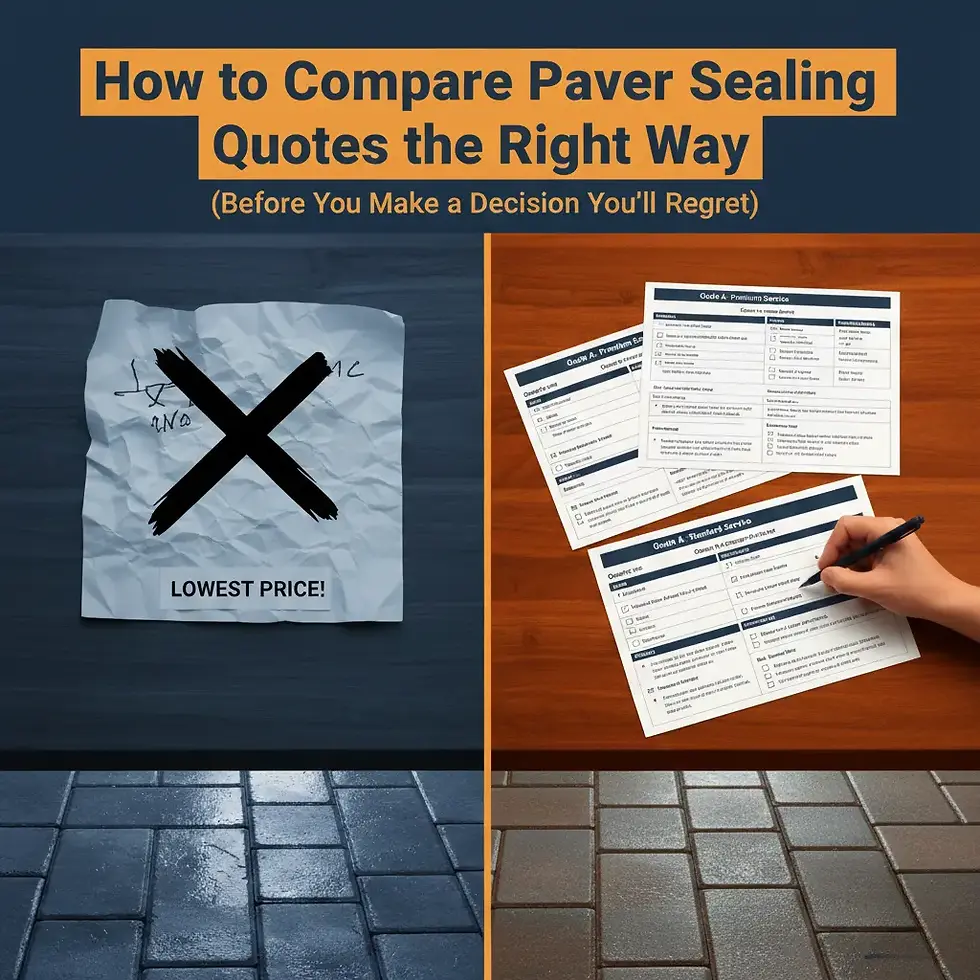
If you've recently received a quote for paver cleaning and sealing and you're in the process of comparing your options, this guide is for you. Getting multiple quotes is a smart move — but only if you know what you're actually comparing. Two quotes that look similar on paper can represent very different outcomes for your driveway or patio, and the gap between them often has nothing to do with the number at the bottom of the page.
Here's a straightforward framework for evaluating paver sealing quotes that will help you make a confident, informed decision — regardless of which contractor you choose.
Start With What the Quote Actually Includes
The most important question to ask about any paver sealing quote is: what does this price cover? A bare-bones quote that lists "cleaning and sealing" as a single line item tells you almost nothing about the scope of work. A detailed quote should clearly outline every phase of the job. At minimum, look for whether the quote includes a pre-inspection and site assessment, any necessary repairs such as re-leveling sunken pavers or re-setting loose border stones, mold and mildew treatment for shaded or organically affected areas, targeted stain removal for rust, oil, or efflorescence, the cleaning method and equipment being used, joint sand type and whether replacement is included, the sealant product and number of coats, and the application method.
If a quote doesn't address most of these — or if the contractor can't answer questions about them clearly — that's meaningful information. Vague scope is how corners get cut without you ever knowing it happened.
Understand That Cleaning Method Is Not a Small Detail
One of the most significant quality differences between paver sealing contractors is the cleaning equipment they use, and it rarely shows up explicitly in a quote. There's a substantial difference between cleaning with a standard pressure washing wand and cleaning with a commercial-grade rotary surface cleaner.
A rotary surface cleaner delivers uniform, high-flow pressure across the entire paver surface simultaneously. It produces a consistent, streak-free clean and flushes contaminated joint sand out of the joints effectively. A standard wand concentrates pressure in a narrow stream that creates visible striping on the surface and doesn't clean the joint areas adequately. Once sealer goes down over a wand-washed surface, those stripes become permanent — and they become more visible as the sealer wears.
Ask any contractor you're evaluating: what equipment do you use to clean the surface? The answer tells you a great deal about what the finished result will look like.
The Sealant Product and Application Method Matter Enormously
Not all sealers are the same. Consumer-grade products available at home improvement stores and professional commercial-grade sealers differ significantly in concentration, UV resistance, and durability. A professionally applied commercial sealer will typically outlast a consumer product by several years, even under identical conditions. Ask each contractor what specific product they're using and whether it's available at retail — if it is, that's a signal worth noting.
Application method is equally important. Spraying sealant rather than rolling it ensures the product reaches the chamfered edges and beveled surfaces of each paver that a roller physically can't access. It also ensures the sealant fully saturates the joint sand to activate and lock it in place. Rolling leaves edges unsealed and frequently pulls joint sand upward, creating an uneven finish. Ask each contractor how they apply the sealer and how many coats are included.
Know What Polymeric Sand Is and Whether It's in the Quote
Joint stabilization — the process of filling paver joints with polymeric sand — is one of the most important components of a comprehensive paver restoration, and it's one of the items most likely to be quietly omitted from a lower-priced quote.
Polymeric sand contains polymer binders that activate with water and harden as they cure, creating a joint compound that resists washout, suppresses weeds, and deters ant infestations. It's a significant upgrade from regular mason's sand, which erodes with rain and seasonal movement and requires constant replenishment. If a competitor's quote is meaningfully lower than another, check whether polymeric sand installation is included. Skipping it reduces the upfront cost but leaves your paver system without the joint stability that protects it long-term.
Verify Licensing, Insurance, and Warranty Before Anything Else
This one is non-negotiable. Any contractor working on your property should be fully licensed and insured, and should be able to provide a certificate of insurance on request. If a contractor is hesitant to provide this or asks you to simply take their word for it, move on.
Warranty is the other credibility signal that's easy to overlook when you're focused on price. A contractor who stands behind their work offers a written warranty with clear terms — not a vague verbal assurance that they'll "come back if there's a problem." Understand what's covered, for how long, and what conditions apply. A 3-year warranty backed by a company with 30 years in business means something very different than a 1-year warranty from a crew that may not be reachable next season.
Be Cautious About Hiring a Non-Specialist
One of the more common mistakes homeowners make when getting paver sealing quotes is not distinguishing between a paver sealing specialist and a contractor who offers it as a secondary or add-on service. Pressure washing companies, painters, handymen, and general landscapers may include paver sealing on their service list — but offering a service and specializing in it are very different things.
Paver sealing done correctly requires an understanding of paver chemistry, sealer compatibility, mold and stain treatment, joint stabilization, and application technique that takes years of focused experience to develop. A pressure washing company, for example, may clean your pavers competently but apply the wrong sealer product for your surface type, skip the mold pre-treatment, or roll instead of spray — any of which can result in a finish that fails, clouds, or peels within a season. A handyman or general contractor may not know the difference between a water-based and solvent-based sealer, let alone how to test which one is compatible with what's already on your pavers.
When sealing is a contractor's primary and specialized service — not an upsell bolted onto a pressure washing route — it shows in every step of the process, the products they carry, the equipment they invest in, and the warranty they're willing to put in writing. Ask any contractor you're evaluating: what percentage of your business is paver cleaning and sealing specifically? The answer is telling.
Experience Is a Legitimate Factor — Not Just a Marketing Line
There's a reason experience matters in paver sealing specifically. Illinois pavers face conditions that require informed decision-making at every step: freeze-thaw cycle damage, efflorescence from winter salt exposure, clay-heavy soil that causes seasonal heaving, and the full spectrum of stain types that come with Chicagoland weather. A contractor with decades of experience in this specific market has encountered and solved every one of these problems many times over. A newer or less specialized crew may not recognize them until it's too late.
Ask how long each contractor has been working specifically on paver cleaning and sealing — not general landscaping or concrete work — and whether they can point to completed projects in your area. In the Chicagoland suburbs, that means experience with the specific conditions that affect communities like Naperville, Hinsdale, Wheaton, Glen Ellyn, Western Springs, Elmhurst, Downers Grove, Burr Ridge, Highland Park, and Lake Forest. Clay-heavy DuPage and Cook County soil, road salt exposure on driveways, and the severity of our freeze-thaw cycles are not the same as what contractors deal with in other parts of the country. Local project history in your specific suburb matters.
Why the Lowest Quote Is Rarely the Best Value
In paver sealing, a significantly lower quote almost always reflects a reduction in scope, product quality, or both. The materials cost of commercial-grade sealer, polymeric sand, and professional cleaning equipment is relatively fixed. A contractor who comes in dramatically under market rate is either using consumer products, skipping preparation steps, applying fewer coats, or employing less experienced labor. Any of these shortcuts produces a result that looks acceptable initially and degrades noticeably within a year or two — at which point the surface needs to be stripped and redone, often at greater expense than the original proper job would have cost.
The right question when comparing quotes isn't "who is cheapest?" It's "who is delivering the most value for what I'm spending?"
A Note From Us
We sent you this guide because we genuinely want you to make the best decision for your home — even if that ultimately means choosing someone else. What we've described above is exactly how we approach every project: a detailed 7-step process, commercial-grade equipment, professional sealants not available at retail, polymeric sand installation, full licensing and insurance, and a 3-year warranty backed by nearly 30 years in the Chicagoland market.
If you have any questions about your quote or want to walk through exactly what's included, we're easy to reach. You can call or text us at 630-866-5292, or visit chicagolandpaversealing.com. We're happy to answer questions with no pressure and no obligation.
Frequently Asked Questions
How do I compare paver sealing quotes from different contractors?
Compare quotes based on scope of work (not just price), cleaning equipment and method, sealant product quality and number of coats, whether polymeric sand is included, licensing and insurance status, and warranty terms. A lower quote almost always reflects a reduction in one or more of these areas.
What questions should I ask a paver sealing contractor before hiring them?
Ask what equipment they use to clean the surface, what sealant product they use and whether it's commercially available at retail, how they apply the sealer and how many coats are included, whether polymeric sand installation is part of the quote, whether they are licensed and insured, and what warranty they offer on their work.
Why is the cheapest paver sealing quote usually not the best value?
The materials cost of professional-grade sealer, polymeric sand, and commercial cleaning equipment is relatively fixed. A significantly lower quote typically means consumer-grade products, skipped preparation steps, fewer coats, or less experienced labor — any of which produces results that degrade faster and often require more expensive correction down the road.
Does polymeric sand need to be part of a paver sealing quote?
Yes, in most cases. Polymeric sand stabilizes paver joints by hardening when activated, resisting washout, suppressing weeds, and deterring ants. It is a core component of a comprehensive paver restoration. Contractors who omit it reduce their upfront cost but leave the paver system without the joint stability it needs to perform long-term.
How do I know if a paver sealing contractor is legitimate?
Ask for a certificate of insurance before work begins — any reputable contractor should provide this without hesitation. Look for a written warranty with clear terms, verifiable local reviews, and a track record working specifically on paver cleaning and sealing in your area. Years of experience in this specific discipline matters more than general contracting experience.
Should I hire a paver sealing specialist or a general contractor?
A paver sealing specialist is strongly preferable. Pressure washing companies, painters, handymen, and general landscapers may offer paver sealing as an add-on service, but the chemistry, equipment, and technique required to do it correctly take years of focused experience to develop. When sealing is a contractor's primary service, it shows in their process, their products, their equipment, and the warranty they're willing to back the work with.


Comments