

Chicagoland Paver Sealing | 29+ Years Serving DuPage, Cook, Will, Kane & Lake Counties | Licensed & Insured
Quick Answer
Brick paver cleaning and sealing in the Chicagoland area typically costs between $2.00 and $4.00 or more per square foot, with most residential projects falling between $2.50 and $3.00 per square foot, with a minimum charge on small projects. The final price depends on surface condition, square footage, joint sand status, sealer type, and site accessibility. A free, no-obligation on-site estimate from Chicagoland Paver Sealing is the only way to give you an accurate number for your specific project.
If you've been searching for paver sealing costs in Naperville, Hinsdale, Lake Forest, or anywhere else in the Chicago suburbs for 2026, you've probably run into two frustrating extremes: a contractor who posts a suspiciously low "starting at" price to get your call, or one who won't give any number at all until they're standing in your driveway.
We're going to do something different. We're going to give you our actual price range, explain every factor that moves that number up or down, and walk you through real-world project examples — so you understand exactly where your job is likely to land before we ever meet.
After nearly 30 years of cleaning and sealing brick paver driveways, patios, walkways, and pool decks across DuPage, Cook, Will, Kane, and Lake counties, we've seen every possible variation of this work. The pricing transparency below is built from that experience — not a marketing tactic.
What Does Paver Sealing Cost in the Chicago Area?
Our pricing for a complete brick paver cleaning and sealing project ranges from $2.00 to $4.00 or more per square foot. The majority of residential projects in the Chicagoland area fall between $2.50 and $3.00 per square foot. Due to logistics, set-up time, etc. we do have a minimum charge for smaller jobs.
That's a wide range — and it exists because no two jobs are the same. A well-maintained 1500 sq ft driveway that has been sealed before requires a fundamentally different scope of work than a 600 sq ft patio that hasn't been touched in a decade, has failing joint sand, and is showing heavy efflorescence. Both are real projects we complete every season. Both deserve to be priced on what they actually require.
The sections below walk through every variable that affects where your project will land within that range.
Pro Tip
Surface condition is the single largest variable in paver sealing costs. Neglected surfaces that require chemical stripping of failed sealant, extensive joint sand replacement, or deep stain removal demand significantly more labor and carry a higher per-square-foot price than routine maintenance.
What Affects the Cost of Paver Cleaning and Sealing?
1. Surface Condition
Surface condition is the single biggest variable in any estimate we provide. Pavers that have been maintained and previously sealed with a quality product require significantly less labor to prepare than surfaces that have been neglected, stained, or never sealed at all. However, in most cases, a patio or driveway that has never been sealed is significantly cheaper than one that was sealed improperly by an unqualified contractor or the dreaded DIY disaster.
Heavy organic growth — algae, moss, lichen, mildew — requires more chemical treatment time, additional cleaning passes, and sometimes multiple rounds of treatment before the surface is ready to accept sealer. Oil and grease staining from vehicles calls for specialty degreasers and added labor that a routine cleaning doesn't need. The more preparation a surface requires to reach a sealable condition, the more that is reflected in the price.
2. Square Footage
Larger projects cost more in total — but they often carry a lower per-square-foot cost than smaller ones. A portion of every job's cost is fixed regardless of size: mobilization, equipment, setup, and travel. As square footage increases, those fixed costs spread across more area, making the per-square-foot rate more favorable. A very small project, by contrast, carries the same fixed costs against less surface area.
3. Joint Sand Condition
For paver surfaces, the state of the joint sand is one of the most important factors we evaluate. Joint sand that is fully intact and stable requires minimal intervention before sealing. Sand that has eroded, washed out in large sections, or been compromised by weed growth may need partial or full replacement before a sealer can be properly applied.
When polymeric sand installation is required, that adds both material cost and labor time to the project — but it's an investment in the long-term stability of your surface. Sealing over failed joints without addressing them first leads to poor results and a shorter sealer lifespan.
4. Type of Sealer
The sealer we recommend for your project depends on your surface type, its condition, and your aesthetic goals. We use UreSeal H2O — a professional-grade, water-based urethane sealer — on the vast majority of our projects. It is not available at hardware or home improvement stores, and it is specifically formulated to perform under the demanding conditions of Illinois winters, including freeze-thaw cycles, road salt exposure, and temperature extremes.
Water-based sealers like UreSeal H2O offer excellent durability, UV resistance, and long-term color stability without the strong odor or extended re-entry time associated with solvent-based alternatives. We recommend water-based sealing to nearly all of our clients, and we'll always explain the reasoning behind any product recommendation before work begins.
The finish level you choose — natural/matte, satin, semi-gloss, or high-gloss wet-look — is a factor in material cost. An anti-skid additive is available when slip and falls are a concern.
5. Whether Previous Sealer Needs to be Stripped
If your pavers were previously sealed — by another contractor or as a DIY project — the condition of that existing sealer matters significantly. Sealer that is in good shape and compatible with our product can often be sealed over with proper preparation. Sealer that is failing, whitening, peeling, hazing, or delaminating must be stripped before any new product goes down.
Stripping failed sealer is a labor-intensive process that adds cost to the project. We identify this during the estimate and will always explain what we found and why stripping is or isn't necessary before pricing the job.
6. Paver Repairs
Cleaning and sealing cannot correct structural issues — it can only protect what's already there. Sunken pavers, raised sections, cracked units, or deteriorated edges that affect the integrity of the surface need to be addressed before sealing makes sense. Repair work is scoped and priced separately from the cleaning and sealing service, and it will always be presented to you as a distinct line item with a clear explanation of what was found.
7. Site Conditions and Accessibility
Easy access, flat grade, proximity to a water source, and open space to work make a job run efficiently. Projects with restricted equipment access — tight landscaping, down a steep grade, or requiring long hose runs from the water source — add time to the job. Time is labor, and labor is factored into the price. If you live in a neighborhood like Lincoln Park or the Gold Coast, please read our guide about paver sealing in the city of Chicago.
8. Chicago's Climate
Paver maintenance in Northern Illinois is not the same as it is in warmer, drier climates. Our region's freeze-thaw cycles — where temperatures swing repeatedly above and below freezing throughout fall and winter — drive moisture into paver joints and beneath the surface, accelerating joint sand erosion and paver movement. Road salt and de-icing chemicals compound the damage. The products we use and the preparation standards we apply are specifically calibrated for this environment, and that expertise is built into every job we price.

Real Project Examples: Where Chicagoland Jobs Fall on the Pricing Spectrum
The examples below are drawn from actual projects completed in the Chicago suburbs. For the privacy of our clients, individual project prices are not shown, but the descriptions give you a realistic sense of what scope of work corresponds to the lower, middle, and upper portions of our pricing range.

Project Example A - Toward the Lower End of the Range
This project in Wheaton, IL was a fairly new installation of Unilock pavers. Approximate size: 500sq/ft. The patio was generally in good shape, however, the homeowner was already experiencing rust stains from their patio furniture and some grease stains from the grill. The homeowners general goal was to remove the stains and protect their investment.
Due to the patio being new, no repairs were necessary. We started the project using an environmentally friendly degreaser and then a rust remover to removal all of the stains. The patio was then deep cleaned using a 28" surface cleaner attached to a commercial grade, low pressure / high volume pressure washer. After the pavers were dry, we touched up the polymeric sand and then sprayed 3 coats of a water based sealant.
Total time: 1 day.
Project Example B - In the Middle of the Range
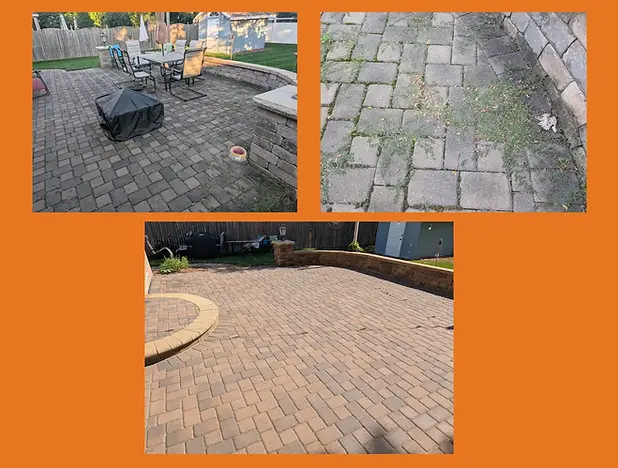
This patio in Woodridge, IL was approximately 20 years old. Approximate size: 800sq/ft. Over time, weeds, mold and lichens had severely taken over the surface. There were areas that had settled, causing drainage issues. The homeowners goal was to have everything cleaned up and make the area usable again.
Due to the amount of weeds, we did a pre-treatment 2 weeks before the scheduled project date. This ensured that the weeds were DEAD and we weren't going to be just cutting off the tops while pressure washing. On day 1, we started with the repairs and releveling of the patio. We then treated the mold/mildew with Concrobium and followed with cleaning the pavers with a surface cleaner attached to a commercial grade, low pressure / high volume pressure washer. After the surface had dried, we stabilized the joints with new polymeric sand and finally sprayed 3 coats of a "wet look" water-based sealant with a semi-gloss finish.
Total time: 2 days.

Project Example C - Toward the Higher End of the Range
This project in Glen Ellyn, IL was 20+ years old and had been severely neglected for years. Approximate size: 2500sq/ft. Heavy tree cover and a DIY disaster resulted in a lot of work needing to be done. The homeowners were planning on listing the home for sale and knew that they needed a serious curb appeal boost. There were multiple patios and walkways on this property that needed attention besides the driveway.
We started with treating the weeds 2 weeks before the scheduled project date to ensure that they were DEAD before we started our 7 Step Restoration Process. There were extensive repairs on this project which took a couple of days. This project required a full chemical stripping of the failed solvent based sealant that the homeowner had applied. We followed up with a deep cleaning of the paver surfaces. We returned the following day, properly stabilized the joints with polymeric sand and finally sprayed 3 coats of a "wet look" water based sealant with a high gloss finish.
Total time: 4 days.
What's Always Included — Regardless of Where Your Project Falls
No matter the size or complexity of your project, every job Chicagoland Paver Sealing completes includes the same foundational commitment:
-
A thorough pre-job walkthrough where we assess the surface together, explain what we found, and walk you through exactly what we're going to do and why — before any work begins.
-
Professional-grade industrial surface cleaning equipment that cleans deeper and more uniformly than consumer-grade pressure washers. The difference in results is visible.
-
Proper surface preparation as a non-negotiable standard. Sealer applied to an inadequately prepared surface fails early and traps contaminants beneath. The prep is the job.
-
UreSeal H2O or a specifically recommended professional-grade sealer matched to your surface type, condition, and goals — with anti-skid additive included in areas where slip and falls are a concern.
-
A post-job walkthrough before we leave to make sure you're satisfied with the result.
-
Our 3-Year Common Sense Warranty on workmanship and material performance, with clear, plain-English terms that explain what's covered and what isn't.
-
Straightforward guidance on what your surface will need going forward to protect your investment and maintain the results. Many homeowners sign up for our Paver Protection Plan.

Why We Don't Use "Starting At" Pricing
You've seen it everywhere: "Paver sealing starting at $0.79/sq ft" or "Driveway sealing from $199." Those numbers exist to generate calls — not to tell you what your project will actually cost.
Homeowners across the Chicago suburbs have told us about experiences where an advertised low price doubled or tripled by the time the job was done, with add-ons explained away after work had already started. That's not a pricing model — it's a bait and switch.
When we give you a price, it's the price. It reflects what we saw on site, what the job actually requires, and what it will take to do it right. We'd rather give you an honest range upfront and walk you through exactly where your project falls than earn a call with a number we can't stand behind.
That's been our approach for 29 years. It's why the majority of our new clients come from referrals.
Frequently Asked Questions About Paver Sealing Costs in Chicagoland
How much does it cost to seal a brick paver driveway in the Chicago suburbs?
Brick paver driveway sealing in the Chicagoland area typically costs between $1.50 and $4.00 or more per square foot. Most residential driveways fall in the $2.00 to $2.50 per square foot range. The final price depends on the size of the driveway, the condition of the surface, whether joint sand work is needed, and the sealer finish selected. A free on-site estimate is the only way to give you an accurate number.
How much does paver patio cleaning and sealing cost?
Patio cleaning and sealing is priced using the same per-square-foot range as driveways: $2.00 to $4.00 or more per square foot, with most projects landing between $2.50 and $3.00. Patio projects sometimes involve more intricate layouts, tighter access for equipment, or adjacent landscape features that add complexity — all of which are accounted for in the estimate.
Do you charge for estimates?
No. Estimates are always free, almost always conducted on-site, and always provided in writing. We walk the surface with you, explain what we find, and give you a clear written scope before you make any decision. There is no pressure and no obligation.
How soon will I receive my estimate after the visit?
You'll typically receive your written estimate within 24 hours of the on-site visit. Most estimates are returned the same day.
Is the price I'm quoted the final price?
Yes, in almost every case. The only exception is if we uncover something during the job that wasn't visible during the estimate — for example, sealer failure beneath the surface that wasn't apparent until cleaning began. In those rare situations, we stop, show you what we found, explain the options, and get your approval before proceeding. You will never receive a surprise invoice.
Why does paver sealing cost more in Illinois than in other states?
Paver maintenance in Northern Illinois is more demanding than in warmer climates. Our freeze-thaw cycles — repeated temperature swings above and below freezing throughout winter — drive moisture into joints and beneath paver surfaces in ways that milder climates don't experience. The products, preparation standards, and expertise required to deliver lasting results in this environment are more involved than in states that don't face these conditions. The additional cost reflects that reality.
How often do brick pavers in the Chicago area need to be cleaned and sealed?
We recommend professional cleaning and sealing every 3 to 5 years for most Chicagoland paver surfaces. Chicago's freeze-thaw cycles, road salt exposure, and UV intensity accelerate the wear on both joint sand and sealer. Surfaces that see heavy vehicle traffic, are exposed to de-icing chemicals, or sit in full sun may benefit from more frequent service.
Can you seal pavers that another contractor already sealed?
Yes, but proper preparation is required first. If the existing sealer is in good condition and compatible with our product, it can typically be sealed over after thorough cleaning. If the existing sealer is failing — showing whitening, peeling, cloudiness, or delamination — it must be stripped before new sealer is applied. Applying fresh sealer over a failing layer is one of the most common mistakes in this industry. We identify the status of any existing sealer during the estimate and price the job accordingly.
Do you offer sealing without cleaning?
No. Sealer applied to an improperly cleaned surface traps contaminants, compromises adhesion, and fails prematurely. Cleaning and sealing is a single integrated process, not two independent services. We do not offer sealing without the cleaning and preparation steps that make it work.
What areas of the Chicago suburbs do you serve?
We serve communities throughout DuPage, Cook, Will, Kane, and Lake counties. Primary service areas include Naperville, Wheaton, Glen Ellyn, Elmhurst, Hinsdale, Oak Brook, Burr Ridge, Downers Grove, Western Springs, La Grange, Clarendon Hills, Highland Park, Lake Forest, Glencoe, Wilmette, Winnetka, Northbrook, Deerfield, Barrington, Arlington Heights, Glenview, Palatine, Geneva, St. Charles, Batavia, Orland Park, and many surrounding communities. If you don't see your town listed, contact us — we likely cover your area.
Do you ever clean and seal patios & driveways in Indiana or Wisconsin?
Due to travel time and logistics we are selective about the projects we take on outside of our normal service area. We occasionally do work in Northwest Indiana in areas such as Valparaiso and Crown Point as well as projects in Milwaukee, Lake Geneva and Delavan. If you think your project would be a good fit for us, we encourage you to reach out. In these cases, we normally ask for a good amount of information, pictures, videos, etc. to make certain that your project is right for us and that there will be no surprises for either party.
Ready to Find Out Where Your Project Falls?
You now have the full picture of how paver cleaning and sealing is priced in the Chicago area — straight from a contractor with 29 years of experience doing this work in this climate.
The next step is simple. We'll come to you, walk your surface, explain what we find, and give you a clear, written, no-obligation estimate that accounts for everything specific to your project.
No pressure. No surprises. No low-ball number that turns into a different conversation on job day.
Call or text: 630-866-5292